Bill Maher performed at my job today. He commented on US politics and that got me to thinking of this little experiement I will perform on this blog. I do not believe that everyone who claims to be Democrat, Republican, Socialist, Communist, etc...really knows what they are saying. I, being a lesbian, do not wholly agree with the Democratic party...but *gasp* how could that be??? I think we allow stereotypes influence the way we vote...like "oh I'm black therefore I must vote for such and such". Every party has a platform in which it discusses the points of interest they want to achieve for their party supporters. Where am I getting at?
I'm going to compare the 1920 Nazi Party Platform against the US ideals.
1) Unification of German People...I can safely say that as Americans we want to be unified as a whole
2)Only Nationals can be citizens of the State. I'm going to interpret this as those who are born in America should be citizens. This point goes on to say non-Nationals can live in Germany as guests of the state.
3) Only Citizens can determine leadership and hold office. I think this is agreeable.
4) All German Citizens should have equal rights. Amen to that
5) Income for those who work...that makes sense
Those are the highlights...
While the Nazi Party Platform clearly is against those of the Jewish faith...it brings up a few good points like
Mandatory physical activities for children as health precautions. Better mother/child health care.
Those who seek to destroy the common good should be punished
The point of my expermient is this:
Read your party guidelines before going off on a political tirade. You'll see that there are some common placed themes and then some that do not agree at all.
Thursday, January 21, 2010

Tuesday, January 19, 2010
NY Historical Society
Before heading back to school I headed into the city with Kate to explore a place that many people have been telling us to go to: the New York Historical Society Museum.
Right by the American Museum of Natural History is a nice sized building that houses some really interesting artifacts and a killer collection of Hudson artists.
The main exhibit is titled Lincoln in New York. The exhibit included documents, clothing, even interactive screens to discuss the career of Lincoln and his visit to New York. They were selling shirts that proclaimed "Lincoln: The most beloved President that New York hated". If you read your history books correctly, New York City did NOT like Lincoln and wanted to side with the South because they were going to lost business. In fact NYC was going to declare itself as a city state so it could trade freely with the North and South.
There was a school group there that wrote letters to Lincoln and one kid said thank you for freeing the slaves...right as I was standing by a sign that proclaimed Lincoln's words explaining how he wouldn't free the slaves if it preserved the Union. I was a horrible being and laughed out loud at the irony.
On display was a military jacket of the first Union victim. Took a nice bullet to the heart. Must have been a bitch to wash the blood out. I should stop being so mean.
I had two favorites sites.
1) The Painting Collection
The NYHSM has one of the largest collections of Hudson artists. Now the paintings were from the 19th century...which I hope I am right, puts us in the Romantic Era of literature, art, and music. One of the main aspects of Romantic art, literature, and music was the focus on nature. There were several oil paintings by Thomas Cole...one stood out to me which was called Catskill Creek.

2) The 4th floor of "stuff"
Up on the 4th floor is literally an artifact haven. Off to the side is the 9/11 collection. While the majority of everything was destroyed on that day, the museum has on display items recovered at the site...mainly port authority cards, a K9's tag, keys, even a pair of shoes from a Survivor. There was a jar of dust that was taken from the scene, and two parts of the airplanes that flew into the buildings. It was just weird to see everyday items on display, but you have to...it's New York history.
Upstairs there are military artifacts. There are guns, knives, swords, uniforms from the police, fire force, Civil War, and even Revolution. That was my favorite site to look at because I like military history (aaaand Nazis...).
The museum is small, but holds quite a lot (including a stagecoach up on the 4th floor). Our day was completed with pizza and beer, a trip to Columbia University, and Carngie Hall and of course Borders.
And I cannot complete this entry without the fact that I bought a book on the Gestapo. So there. There is my Nazi reference, Kate.
Right by the American Museum of Natural History is a nice sized building that houses some really interesting artifacts and a killer collection of Hudson artists.
The main exhibit is titled Lincoln in New York. The exhibit included documents, clothing, even interactive screens to discuss the career of Lincoln and his visit to New York. They were selling shirts that proclaimed "Lincoln: The most beloved President that New York hated". If you read your history books correctly, New York City did NOT like Lincoln and wanted to side with the South because they were going to lost business. In fact NYC was going to declare itself as a city state so it could trade freely with the North and South.
There was a school group there that wrote letters to Lincoln and one kid said thank you for freeing the slaves...right as I was standing by a sign that proclaimed Lincoln's words explaining how he wouldn't free the slaves if it preserved the Union. I was a horrible being and laughed out loud at the irony.
On display was a military jacket of the first Union victim. Took a nice bullet to the heart. Must have been a bitch to wash the blood out. I should stop being so mean.
I had two favorites sites.
1) The Painting Collection
The NYHSM has one of the largest collections of Hudson artists. Now the paintings were from the 19th century...which I hope I am right, puts us in the Romantic Era of literature, art, and music. One of the main aspects of Romantic art, literature, and music was the focus on nature. There were several oil paintings by Thomas Cole...one stood out to me which was called Catskill Creek.

2) The 4th floor of "stuff"
Up on the 4th floor is literally an artifact haven. Off to the side is the 9/11 collection. While the majority of everything was destroyed on that day, the museum has on display items recovered at the site...mainly port authority cards, a K9's tag, keys, even a pair of shoes from a Survivor. There was a jar of dust that was taken from the scene, and two parts of the airplanes that flew into the buildings. It was just weird to see everyday items on display, but you have to...it's New York history.
Upstairs there are military artifacts. There are guns, knives, swords, uniforms from the police, fire force, Civil War, and even Revolution. That was my favorite site to look at because I like military history (aaaand Nazis...).
The museum is small, but holds quite a lot (including a stagecoach up on the 4th floor). Our day was completed with pizza and beer, a trip to Columbia University, and Carngie Hall and of course Borders.
And I cannot complete this entry without the fact that I bought a book on the Gestapo. So there. There is my Nazi reference, Kate.
Sunday, January 17, 2010
The Moon is Down ~ John Steinbeck
So I just finished reading John Steinbeck's, The Moon is Down. It was a weird story but I really liked it for some reason. The book is about a town during World War Two that is taken over and the Mayor of the town is forced to follow the orders of the conquerers. The cool thing about this story is that it is kind of warped in its own way. It deals with law and order and what happens when two heirarchys clash. The Mayor speaks for his town and people, while the conquerers try to establish their government in the town. The citizens rebel and this causes many undeserved deaths and mass killings....I guess I shouldn't say much more in case there is anyone out there that wants to read the story.
Tuesday, January 12, 2010
John Wilkes Booth
This is the man who assassinated President Lincoln on April 15th 1865. After reading Jay Winnik's "April 1865" the story of this man has become a little more clear. It turns out that Booth has had an obsession with the president from the moment he stepped into office. Booth, who was a former famous actor who frequently performed at Ford's Theater in washington D.C. (where the president was assassinated), hated the president because he was a die hard southerner who was also a white supremacist. He was the youngest of 10 from a Maryland family, and always identified himself as a southerner even though where he lived was considered a borderline state. For years he had been secretly plotting to either kill, kidnap, or torure the president. He followed him on his routes to meetings, leisure time, and even back to the white house. He made sure to keep a far enough distance so the president's security would not pick up on anything suspicious. eventually when Lincoln gave his final speech, Booth was the one that determined it would be his last. He was absolutely fed up and disgusted by Lincoln's wanting to emancipate the slaves and untimately put an end to the war. The assassin wanted nothing more than to continue the fight and show his loyalty to his southern roots. When he eventually pulled the trigger and lodged the bullet into the back of his head, he immediately headed back to the south to brag about his success. In his mind this man truly felt that he did the entire nation a good deed and took care of a nationwide problem...
Who would have ever guessed that the man that killed President Lincoln was once actually a well known and famous actor who the President himself actually loved watching in his performances...
Who would have ever guessed that the man that killed President Lincoln was once actually a well known and famous actor who the President himself actually loved watching in his performances...
Saturday, January 9, 2010
Untitled
This will be a little different than most posts because this story is one of my own, one that deserves all the recognition and honor it can possibly get. This is a story about an all American boy who grew up living the American dream. He served his country in the second world war, he raised a family, and he represented everything that America is and always will be in my heart. This is the story of my Great-Grandfather Julius "George" Hoffman. For anyone who ever reads this, please hold a special place in your heart for this man because he was the true definition of a hero, especially to me. Sadly my grandfather passed away on May 6th, 2009, but his memory lives on forever, and his family loves and misses him more than words could ever describe.
He was born on July 15th, 1922 in the Bronx, New York. This is where he would spend the rest of his life, where he would live out his childhood, marry his long time sweetheart, raise a family, and be laid to rest. There is so much more in between these events, I only wish I could write the story of his life one hundred percent accurrate.
My Grandfather was one of the kindest and most humble man you could ever meet. He was your all-American boy who grew up playing baseball, which my Grandma always claimed was his first true love. He played baseball all his life, and was a Brooklyn dodgers, Yankees, and Mets fan. He loved the game and everything about it. When I talked to him about baseball there was this light in his eye that made him smile, he looked so happy and so passionate about the game. He was both a player and manager of his teenage baseball team called "the Wings." I have a picture of his team, it is him and his buddies in their uniforms taking their team photo. I wish I had the chance to talk about his team more with him because the stories he would have told me would be absolutely amazing.
In 1945, right after the war ended and my Grandpa returned home from Guam, he married his childhood sweetheart that he knew and played with since the age of 3, Marie Casario. They were a match made in heaven. Not only were they the perfect couple, they would together build a family that honors and loves them more than anything for generations. If I could truly tell the story of how amazing my grandparents are, I would have written it years ago. My Grandma who is still alive today continues to fill my heart with love, stories, and memories that I will have for the rest of my life. I once told her how proud I am of her for all her support when my Grandpa was sick, and for how she held up and was strong for everyone. she is the grandma that everyone dreams of and wants to be their own, shes just an average woman who lights up anyones life that she has touched.
Together my grandparents had two boys, George and Tommy, who both grew up loving baseball as well along with toy trains, classic movies, childhood sweethearts, and much more. They then started families of their own and thats how I came into the picture a few generations later.
My Grandfather deserves to be honored for living out the American dream and doing it the traditional and honest way.
He grew up in the bronx and always said that it was his home and where he loved to be. that could be one of the reasons why they never went on many vacations far from home. He served for 4 years during World War Two, and he later married the love of his life and started a family. He worked in the post office for over thirty years and was given a pension that he deserved every penny of. When he retired he and my grandma began volunteering in the Bronx Zoo, they would do that for nearly 20 years and my grandma still does that today. she can give a tour of that place better than anyone I know.
I try hard not to think of my Grandpa when he was sick. It was one of the worst periods in my life and I hate knowing that he suffered for so long with his blood disease and cancer. So I remember all the great times I have had with him and all the amazing things that he has done for my family and me. He loved making people happy and he loved to love. He was the most honorable and respectable man I have ever known, and if I had one more chance to talk to him I would tell him that he is my hero, not because he did something drastic to get publicity, but for the fact that he was just himself, my grandpa, my hero and my friend. I know he loved me so much because I could just see it in him everytime we were together.
So before I close out this post, the reason I wrote this is because I feel that everyone in some way is a part of our country's history. I believe that all the war veterans, all the mothers raising families, all the friends, relatives, teachers, mentors, coaches, doctors, and everyone in this country deserve to be thanked for their contributions to society and for simply being them. I honestly feel that love alone is the one thing that can make someone smile and truly happy. I feel that this country in some of the darkest of times has survived out of love and dedication. I want to thank everyone who has told someone in their life that they love them, and I want to especially thank my Great-Grandfather for being the man that he was and always will be. He is a hero.
Rest in Peace Grandpa, I love you.
July 15th, 1922- May 6th, 2009
He was born on July 15th, 1922 in the Bronx, New York. This is where he would spend the rest of his life, where he would live out his childhood, marry his long time sweetheart, raise a family, and be laid to rest. There is so much more in between these events, I only wish I could write the story of his life one hundred percent accurrate.
My Grandfather was one of the kindest and most humble man you could ever meet. He was your all-American boy who grew up playing baseball, which my Grandma always claimed was his first true love. He played baseball all his life, and was a Brooklyn dodgers, Yankees, and Mets fan. He loved the game and everything about it. When I talked to him about baseball there was this light in his eye that made him smile, he looked so happy and so passionate about the game. He was both a player and manager of his teenage baseball team called "the Wings." I have a picture of his team, it is him and his buddies in their uniforms taking their team photo. I wish I had the chance to talk about his team more with him because the stories he would have told me would be absolutely amazing.
In 1945, right after the war ended and my Grandpa returned home from Guam, he married his childhood sweetheart that he knew and played with since the age of 3, Marie Casario. They were a match made in heaven. Not only were they the perfect couple, they would together build a family that honors and loves them more than anything for generations. If I could truly tell the story of how amazing my grandparents are, I would have written it years ago. My Grandma who is still alive today continues to fill my heart with love, stories, and memories that I will have for the rest of my life. I once told her how proud I am of her for all her support when my Grandpa was sick, and for how she held up and was strong for everyone. she is the grandma that everyone dreams of and wants to be their own, shes just an average woman who lights up anyones life that she has touched.
Together my grandparents had two boys, George and Tommy, who both grew up loving baseball as well along with toy trains, classic movies, childhood sweethearts, and much more. They then started families of their own and thats how I came into the picture a few generations later.
My Grandfather deserves to be honored for living out the American dream and doing it the traditional and honest way.
He grew up in the bronx and always said that it was his home and where he loved to be. that could be one of the reasons why they never went on many vacations far from home. He served for 4 years during World War Two, and he later married the love of his life and started a family. He worked in the post office for over thirty years and was given a pension that he deserved every penny of. When he retired he and my grandma began volunteering in the Bronx Zoo, they would do that for nearly 20 years and my grandma still does that today. she can give a tour of that place better than anyone I know.
I try hard not to think of my Grandpa when he was sick. It was one of the worst periods in my life and I hate knowing that he suffered for so long with his blood disease and cancer. So I remember all the great times I have had with him and all the amazing things that he has done for my family and me. He loved making people happy and he loved to love. He was the most honorable and respectable man I have ever known, and if I had one more chance to talk to him I would tell him that he is my hero, not because he did something drastic to get publicity, but for the fact that he was just himself, my grandpa, my hero and my friend. I know he loved me so much because I could just see it in him everytime we were together.
So before I close out this post, the reason I wrote this is because I feel that everyone in some way is a part of our country's history. I believe that all the war veterans, all the mothers raising families, all the friends, relatives, teachers, mentors, coaches, doctors, and everyone in this country deserve to be thanked for their contributions to society and for simply being them. I honestly feel that love alone is the one thing that can make someone smile and truly happy. I feel that this country in some of the darkest of times has survived out of love and dedication. I want to thank everyone who has told someone in their life that they love them, and I want to especially thank my Great-Grandfather for being the man that he was and always will be. He is a hero.
Rest in Peace Grandpa, I love you.
July 15th, 1922- May 6th, 2009
Thursday, January 7, 2010
1930's Hollywood
One of the coolsest things about being a history major (especially in American Studies) is that you get to focus in on specific periods and events throughout American History. One of the most intriguing decades I feel, is the 1930's. The 1930's was considered one of the worst periods our country has ever experienced. It was the era of the Great Depression, the dustbowl, and economic failure. One of the coolest things to learn about is Hollywood and was it was like during this time. The movies made in the 30's primarily revolved around the depression and many of the story lines involved issues dealing with the depression and how Americans lived during this difficult time. Here are some of the movies that I really enjoyed watching in my film class...
The Grapes of Wrath, Imitation of life, It Happened One Night, Meet John Doe, Grand Hotel, The Littlest Rebel, King Kong, Sullivan's Travels, Modern Times, and many more.
All these movies dealt with issues during the Great Depression. One of the really cool aspects were the movie studios during this time. The major companies in the 1930's were MGM, which was considered to be the best studio to work for because they paid the highest salaries and their heads were great people to work with (Irving Thalberg and Louis Mayer being the most popular). Columbia and Universal were two other decent companies to work for, but didnt even make the charts compared to MGM...
A little history about MGM studios goes like this. The company started out with its founder Louis Mayer. Mayer was a guy who loved working with others and collaborating with some of the most creative people alive. He hired one of his good friends, Irving Thalberg to help get the company up and running. The studio quickly became a success with hiring the best and most ellogant actors and actresses during that time. Some of these famous stars included Claudette Colbert, James Cagney, and even little Shirley Temple. These stars were treated very well compared to the other studios. They were paid the highest salaries and were given the most freedom to move around and try out new things in their careers. People wanted to work for Mayer and Thalberg because that was where the money and creativity was. Box-office hits such as Grand Hotel and It Happened One Night are what made this studio such a success. Movies such as the Wizard of Oz would later only add to the name.
Hollywood was really one of the only places that was not spiraling out of control during the Great Depression. During this time banks, firms, homeowners, and employees were all feeling the effects of just how terrible this crisis really was. Automotive compainies had to even stop production for quite some time to make ends meet when they werent making profits.
The one good thing that Americans had during this time was the movies. It was extremely cheap to go see a movie, at the time tickets only cost about 5 cents. When people wanted a break from reality especially the reality of the recession, many saw the movies as an outlet. Movies provided many with comic releif, hope, and inspiration during a time where there was not much to look foward to besides a potential meal on the dinner table if you were lucky.
There is just so much to know about 1930's Hollywood. It was a decade that stands out from the rest and it was a time where the companies were more creative than ever. This was the time where some of the classics we have come to know today were made. Movies like the Public Enemy and King Kong have been remade over and over becuase they have had such a lasting effect of audiences for decades now. Hollywood became as huge as it is today becuase of the directors, stars, and producers who made it what it truly was, a success.
The Grapes of Wrath, Imitation of life, It Happened One Night, Meet John Doe, Grand Hotel, The Littlest Rebel, King Kong, Sullivan's Travels, Modern Times, and many more.
All these movies dealt with issues during the Great Depression. One of the really cool aspects were the movie studios during this time. The major companies in the 1930's were MGM, which was considered to be the best studio to work for because they paid the highest salaries and their heads were great people to work with (Irving Thalberg and Louis Mayer being the most popular). Columbia and Universal were two other decent companies to work for, but didnt even make the charts compared to MGM...
A little history about MGM studios goes like this. The company started out with its founder Louis Mayer. Mayer was a guy who loved working with others and collaborating with some of the most creative people alive. He hired one of his good friends, Irving Thalberg to help get the company up and running. The studio quickly became a success with hiring the best and most ellogant actors and actresses during that time. Some of these famous stars included Claudette Colbert, James Cagney, and even little Shirley Temple. These stars were treated very well compared to the other studios. They were paid the highest salaries and were given the most freedom to move around and try out new things in their careers. People wanted to work for Mayer and Thalberg because that was where the money and creativity was. Box-office hits such as Grand Hotel and It Happened One Night are what made this studio such a success. Movies such as the Wizard of Oz would later only add to the name.
Hollywood was really one of the only places that was not spiraling out of control during the Great Depression. During this time banks, firms, homeowners, and employees were all feeling the effects of just how terrible this crisis really was. Automotive compainies had to even stop production for quite some time to make ends meet when they werent making profits.
The one good thing that Americans had during this time was the movies. It was extremely cheap to go see a movie, at the time tickets only cost about 5 cents. When people wanted a break from reality especially the reality of the recession, many saw the movies as an outlet. Movies provided many with comic releif, hope, and inspiration during a time where there was not much to look foward to besides a potential meal on the dinner table if you were lucky.
There is just so much to know about 1930's Hollywood. It was a decade that stands out from the rest and it was a time where the companies were more creative than ever. This was the time where some of the classics we have come to know today were made. Movies like the Public Enemy and King Kong have been remade over and over becuase they have had such a lasting effect of audiences for decades now. Hollywood became as huge as it is today becuase of the directors, stars, and producers who made it what it truly was, a success.
Tuesday, January 5, 2010
Furtwangler and the Nazi Party
Nazis and music are two subjects that I love to research. When they come together it's even more enjoyable for me. This entry is about Wilhelm Furtwangler.

Wilhelm Furtwangler (1886-1954) was a German conductor/composer during the Nazi regime. He conducted the Berlin Philharmonic Orchestra. He did NOT approve of the Nazi regime, and would not give the Nazi salute. This caused him to be a target of the Nazi party, and he too fled to Switzerland to avoid arrest. He was chosen to premiere Hindemith's Mathis del Maler but the Nazis prevented the piece from being performed.
The twisted thing that I want to point out is at the end of this video
Watch until the very end when Joseph Goebbels comes up to shake hands with Furtwangler. He holds onto the Furtwangler's hand, and at the very end he switches the hankerchief from his left hand to his right hand to wipe away the touch of the Nazis. This is one of the coolest pieces of footage I've seen of bold protest against the Nazis in the music world.

Wilhelm Furtwangler (1886-1954) was a German conductor/composer during the Nazi regime. He conducted the Berlin Philharmonic Orchestra. He did NOT approve of the Nazi regime, and would not give the Nazi salute. This caused him to be a target of the Nazi party, and he too fled to Switzerland to avoid arrest. He was chosen to premiere Hindemith's Mathis del Maler but the Nazis prevented the piece from being performed.
The twisted thing that I want to point out is at the end of this video
Watch until the very end when Joseph Goebbels comes up to shake hands with Furtwangler. He holds onto the Furtwangler's hand, and at the very end he switches the hankerchief from his left hand to his right hand to wipe away the touch of the Nazis. This is one of the coolest pieces of footage I've seen of bold protest against the Nazis in the music world.
Monday, January 4, 2010
Sparta
Out of the city states of Greece, Sparta happens to be my favorite...and not because Lena Headey was a striking Spartan lady in 300 
What I found appealing was their dedicated nature, and militant lifestyle.
The life of a Spartan boy began training at age 7. He was taken away frmo his mother and trained in combat. A boy wuold learn to resist pain and would exhaust himself to beat odds. Training consisted of martial training as well as athletics. At age 20 the young man would be enrolled in the army. For ten years he would serve the Spartan army, and then be considered an equal man under Spartan law at age 30. Service was required until age 60.
A Spartan could marry but had to sneak away from the army to be with his wife. If caught, he was punished for deserting. Women were also given the same training (minus military) and were held to expectations as high as the men. This type of isolated training defined the Spartan mindset to be one of glory, and that nothing could get in the way of achieving that glory.
The government was headed by two kings, ruling equally with a backgroud of military and religion. The army would never leve home without a king, so in a way that covered bases at home and in the field. There was a council of elders that checked on the kingships so there was a checks and balance system. A special council was called the board of ephors who were 5 specially selected men who checked on the kings's powers and controlled foreign policies, presided at assemblies, among other important functions.
Many saw Sparta as a set up for a utopian society. Men and women were both trained in body, and their minds belonged to the government. Their army was feared because a Spartan would never give up. There's a story that the Spartans before the eve of battle would brush their long hair in preparation to die. Whether we see them as battle hard warriors or men who brush their hair before dying, one thing is for certain...They were some of the badass warriors that Ancient Greece had to fear.
Their dedication and loyalty to the state is one to be reckon with, and they were able to merge education, military strategies, and civic service to perfection.


What I found appealing was their dedicated nature, and militant lifestyle.
The life of a Spartan boy began training at age 7. He was taken away frmo his mother and trained in combat. A boy wuold learn to resist pain and would exhaust himself to beat odds. Training consisted of martial training as well as athletics. At age 20 the young man would be enrolled in the army. For ten years he would serve the Spartan army, and then be considered an equal man under Spartan law at age 30. Service was required until age 60.
A Spartan could marry but had to sneak away from the army to be with his wife. If caught, he was punished for deserting. Women were also given the same training (minus military) and were held to expectations as high as the men. This type of isolated training defined the Spartan mindset to be one of glory, and that nothing could get in the way of achieving that glory.
The government was headed by two kings, ruling equally with a backgroud of military and religion. The army would never leve home without a king, so in a way that covered bases at home and in the field. There was a council of elders that checked on the kingships so there was a checks and balance system. A special council was called the board of ephors who were 5 specially selected men who checked on the kings's powers and controlled foreign policies, presided at assemblies, among other important functions.
Many saw Sparta as a set up for a utopian society. Men and women were both trained in body, and their minds belonged to the government. Their army was feared because a Spartan would never give up. There's a story that the Spartans before the eve of battle would brush their long hair in preparation to die. Whether we see them as battle hard warriors or men who brush their hair before dying, one thing is for certain...They were some of the badass warriors that Ancient Greece had to fear.
Their dedication and loyalty to the state is one to be reckon with, and they were able to merge education, military strategies, and civic service to perfection.

Sunday, January 3, 2010
Seward and Lincoln assassinations
the story of President Lincoln's assassination along with secretary of State William Seward was pretty crazy as well as interesting.
Lincoln and his wife Mary planned to see the play "Our American Cousin" at the Ford's theater in Washington on April 14th, 1865. They made it to the play twenty minutes late due to bad weather conditions, but saw the first three acts of the performance. The president's body guard at the time was blocking the outside door of the box seat reserved for the lincolns that night. He politely excuses himself just before the forth act to have a drink and a smoke. This is where the assassins plan comes into effect. The actor, John Wilkes Booth sees the opportunity and shoots Lincoln at point blank range in the back of the head. This causes complete chaos in the theater and then people immediately jump to the idea that a full blown confederate attack was taking place. Lincolns men grab him and take him away to a home owned by a doctor who tried to save him, he eventually gives out and passes away.
In the meantime Booth takes off with an injured leg and flees the town as quick as possible. He hides out in the wooded areas for a few days before him and his accomplice are trapped by union soldiers.
The thought of what Lincoln could have done had he not been murdered is sad. Once the president's second term was over he had plans to continue to practice law and take many trips around the world. His wife Mary always talked about exploring Europe one day and taking a trip to Vienna. Lincoln also wanted to travel as well but was looking foward to the idea of living a quiet and "humble" life after four antagonizing years of war. Had he survived to do these things maybe some of the events of the civil war would have turned out different, and Lincoln's reconstruction plan would have been a success.
William Seward is one of my favorite men in American history. His ideas on closing the borders and acquiring Alaska were huge steps toward American freedom as well as stepping stones in the United States becoming one of the biggest commercial nations in the world. Seward always seemed to have a good head on his shoulders and lincoln considered him to be his right hand man. They rarely disagreed with one another, and it is clear throughout Lincoln's presidency that he trusted many of Sewards ideas both on war and economics.
seward was assassinated on the same night as Lincoln, but in a much different way. Seward was attacked in his own home, literally his own bed. A man by the name of George Atzerodt walked up the steps of the seward home and was prepared to take out anyone that came in his way. he shot William's son Frederick twice, killed a maid, and three other residents. He then walked straight into sewards bedroom and stabbed him five times in the heart. Seward fell from his bed and died in a pool of blood. He never had a chance to escape.
These murders were as hanius as they come. The assassinations were intentional and there was a third plot to kill Vice President Andrew Johnson as well. After these events the country, specifically the north was left with more questions than ever. who would lead the nation? was guerilla warfare their last resort? would the war continue for months even years on end? All these questions were left in the minds of every American living during the time.
Had Seward lived longer, this country would be completely different because he would have likely become a presdient at some point in time.
Lincoln and his wife Mary planned to see the play "Our American Cousin" at the Ford's theater in Washington on April 14th, 1865. They made it to the play twenty minutes late due to bad weather conditions, but saw the first three acts of the performance. The president's body guard at the time was blocking the outside door of the box seat reserved for the lincolns that night. He politely excuses himself just before the forth act to have a drink and a smoke. This is where the assassins plan comes into effect. The actor, John Wilkes Booth sees the opportunity and shoots Lincoln at point blank range in the back of the head. This causes complete chaos in the theater and then people immediately jump to the idea that a full blown confederate attack was taking place. Lincolns men grab him and take him away to a home owned by a doctor who tried to save him, he eventually gives out and passes away.
In the meantime Booth takes off with an injured leg and flees the town as quick as possible. He hides out in the wooded areas for a few days before him and his accomplice are trapped by union soldiers.
The thought of what Lincoln could have done had he not been murdered is sad. Once the president's second term was over he had plans to continue to practice law and take many trips around the world. His wife Mary always talked about exploring Europe one day and taking a trip to Vienna. Lincoln also wanted to travel as well but was looking foward to the idea of living a quiet and "humble" life after four antagonizing years of war. Had he survived to do these things maybe some of the events of the civil war would have turned out different, and Lincoln's reconstruction plan would have been a success.
William Seward is one of my favorite men in American history. His ideas on closing the borders and acquiring Alaska were huge steps toward American freedom as well as stepping stones in the United States becoming one of the biggest commercial nations in the world. Seward always seemed to have a good head on his shoulders and lincoln considered him to be his right hand man. They rarely disagreed with one another, and it is clear throughout Lincoln's presidency that he trusted many of Sewards ideas both on war and economics.
seward was assassinated on the same night as Lincoln, but in a much different way. Seward was attacked in his own home, literally his own bed. A man by the name of George Atzerodt walked up the steps of the seward home and was prepared to take out anyone that came in his way. he shot William's son Frederick twice, killed a maid, and three other residents. He then walked straight into sewards bedroom and stabbed him five times in the heart. Seward fell from his bed and died in a pool of blood. He never had a chance to escape.
These murders were as hanius as they come. The assassinations were intentional and there was a third plot to kill Vice President Andrew Johnson as well. After these events the country, specifically the north was left with more questions than ever. who would lead the nation? was guerilla warfare their last resort? would the war continue for months even years on end? All these questions were left in the minds of every American living during the time.
Had Seward lived longer, this country would be completely different because he would have likely become a presdient at some point in time.
Emancipation as a weapon in the Civil War
Only after 1863 did the North officially declared abolition of slavery as the focal point of the Civil War. Before that I believe the war was a result of two economies struggling to exist side by side. Lincoln first and foremost wanted to compromise between the two sides. The North wanted every man to have the chance to prosper through free labor. Slavery put a damper on the ideology of free labor. Slavery “spawned a social order consisting of degraded slaves, poor whites with no hope of advancement, and idle aristocrats” (Foner 463) according to the ideology of free labor.
In comparison of economies, The North was highly industrious; it had mills and factories. The image of "colonial" America was becoming a page in history. People were becoming more dependent on manufactured goods rather than producing for themselves. Women were working through out work, and white women were being used as nurses and teachers in both the North and South during the war and Reconstruction. The South was still the sight of the plantation, dependent on the land to make their living. Slavery was a huge money maker in cotton lands rather than tobacco lands. To be honest, one of the reasons why the North stopped returning slaves to the South during the war was because they realized they were handing back the South’s economy!
While we pride Lincoln on being a great abolitionist, he was also a good politician. He wanted to hold back emancipation until he absolutely had to. It wasn’t his primary goal until 1863 when free and enslaved blacks fought to change minds. In fact in 1862 while meeting with black leaders, he attempted to persuade leaders to a migration back to Africa and islands off the Haitian coast.
The conclusion to “free” the slaves in 1863 was also a decision to persuade Britain from acknowledging the South as an independent nation. But above all the decision to declare the Proclamation on January 1, 1863 was to bolster the acceptance of free blacks in the North after a “win”…this “win” being the retreat of Lee’s troops at Antietam. He issued a statement telling the South to lay down arms or else abolition will become the North’s new weapon.
While abolition did occur, I feel too much emphasis is based on Lincoln’s “Emancipator” image. He really used politics and Emancipation as a last resort because in reality he wanted to preserve the Union as a whole. I’m not saying he doesn’t deserve the acknowledgment he has, but to look at all the facts and realize…he was also a simple human with a brain.
Work Cited
Foner, Eric. Give Me Liberty!: An American History. 2nd ed. Vol. 1. New York: W.W. Norton & Company, 2009.
In comparison of economies, The North was highly industrious; it had mills and factories. The image of "colonial" America was becoming a page in history. People were becoming more dependent on manufactured goods rather than producing for themselves. Women were working through out work, and white women were being used as nurses and teachers in both the North and South during the war and Reconstruction. The South was still the sight of the plantation, dependent on the land to make their living. Slavery was a huge money maker in cotton lands rather than tobacco lands. To be honest, one of the reasons why the North stopped returning slaves to the South during the war was because they realized they were handing back the South’s economy!
While we pride Lincoln on being a great abolitionist, he was also a good politician. He wanted to hold back emancipation until he absolutely had to. It wasn’t his primary goal until 1863 when free and enslaved blacks fought to change minds. In fact in 1862 while meeting with black leaders, he attempted to persuade leaders to a migration back to Africa and islands off the Haitian coast.
The conclusion to “free” the slaves in 1863 was also a decision to persuade Britain from acknowledging the South as an independent nation. But above all the decision to declare the Proclamation on January 1, 1863 was to bolster the acceptance of free blacks in the North after a “win”…this “win” being the retreat of Lee’s troops at Antietam. He issued a statement telling the South to lay down arms or else abolition will become the North’s new weapon.
While abolition did occur, I feel too much emphasis is based on Lincoln’s “Emancipator” image. He really used politics and Emancipation as a last resort because in reality he wanted to preserve the Union as a whole. I’m not saying he doesn’t deserve the acknowledgment he has, but to look at all the facts and realize…he was also a simple human with a brain.
Work Cited
Foner, Eric. Give Me Liberty!: An American History. 2nd ed. Vol. 1. New York: W.W. Norton & Company, 2009.
Saturday, January 2, 2010
Robert E Lee v General Grant
The story for these two guys is seriously crazy. Robert Lee was the commanding general for the confederate states of America, leading the North Virginia regiments, and General Grant was the commanding general for the Union.
The way the two tried to outdo each other is pretty cool. Although Lee was losing the war, he always remained in good spirits and tried to encourage his men, or what was left of them. This guy was really cool because he knew alot of tricks and ways to outsmart the union, but unfortuantely he was never given much credit for it. He tried as best as he could to keep away from resorting to guerilla warfare. Once the Union advanced to North Virginia and bombed Richmond, Lee knew it was time to face Grant and arrange to formally surrended.
Lee met the General in a small farm house in Appotomax and they were actually on good terms with one another. the meeting went a lot better than both of the generals expected. Grant was willing to sign the truce without making the confederates pay for their crimes. He even gave Lee the benefit of giving his men the horses and cattle that they took from the union to use during the war. The last thing that both Grant and Lincoln wanted was to "punish" the south. Instead they wanted to begin reconstruction immediately and do it in the most honorable way.
The really cool thing about General Grant was that he hated being in the military all his life, and almost did not graduate from West Point because he was a slacker. Grant enjoyed poetry and hanging out with friends more than actual study and training. He was a good man, especially to his family. All Grant really wanted to do with his life was manage a farm and have a family, but he took up the military and the offer to become one of Lincoln's generals to help pay for his land. Who would have ever guessed that Grant would turn out to be one of the most respectful and honorable generals yet alone a future President of the United States.
The way Lee and Grant were able to work with one another and keep their words was really cool to find out becuase their are not many people in American History that can honestly be awared for that.
The way the two tried to outdo each other is pretty cool. Although Lee was losing the war, he always remained in good spirits and tried to encourage his men, or what was left of them. This guy was really cool because he knew alot of tricks and ways to outsmart the union, but unfortuantely he was never given much credit for it. He tried as best as he could to keep away from resorting to guerilla warfare. Once the Union advanced to North Virginia and bombed Richmond, Lee knew it was time to face Grant and arrange to formally surrended.
Lee met the General in a small farm house in Appotomax and they were actually on good terms with one another. the meeting went a lot better than both of the generals expected. Grant was willing to sign the truce without making the confederates pay for their crimes. He even gave Lee the benefit of giving his men the horses and cattle that they took from the union to use during the war. The last thing that both Grant and Lincoln wanted was to "punish" the south. Instead they wanted to begin reconstruction immediately and do it in the most honorable way.
The really cool thing about General Grant was that he hated being in the military all his life, and almost did not graduate from West Point because he was a slacker. Grant enjoyed poetry and hanging out with friends more than actual study and training. He was a good man, especially to his family. All Grant really wanted to do with his life was manage a farm and have a family, but he took up the military and the offer to become one of Lincoln's generals to help pay for his land. Who would have ever guessed that Grant would turn out to be one of the most respectful and honorable generals yet alone a future President of the United States.
The way Lee and Grant were able to work with one another and keep their words was really cool to find out becuase their are not many people in American History that can honestly be awared for that.
Civil War: First Modern War?
This was an essay question taken from my American Civ class. What made the Civil War the first modern war?
Reason 1: The vast amount of people that fought in the war. There were 22 million people to use in fighting for the North, whereas the South only had 9 million people. Within that 9 million deep pool, 3.3 million were slaves. This allowed for Generals Grant and Lee to use each other's ecomonies and population as strategies. Grant would exhaust the South...physically and morally...because he had the greater amount of men to use. It would be like an never-ending wave after wave of men. Lee would use the North's industrious economy mindset to his advantage...wishing to exhaust all efforts to supply, feed, and finance the North army.
Reason 2: The Civil War was one of the first wars to of modern weapons. The Revolution, the War of 1812, the Mexican-American War, etc. used muskets. Stuff the bullet which was quite a large ball of metal, stuff it down with some powder and ignite so the bullet can fly. The musket was revolutionized during the Civil War Era by the concept of the rifle. The rifle allowed accuracy on moving targets. A ridge within the barrel helped the bullet maintain its path, so the shooter could hit a moving target better than a musket. Whereas with a musket you would shoot straight ahead and pray you hit something, the rifle was deadlier. Running soliders had more of a chance of being hit than ever before.

Reason 3: The Civil War was bloody on the field and in the operating room. Medical treatments resulted heavily on amputation. This is where we see amputation sky rocket as an effort to save soldiers's lives.
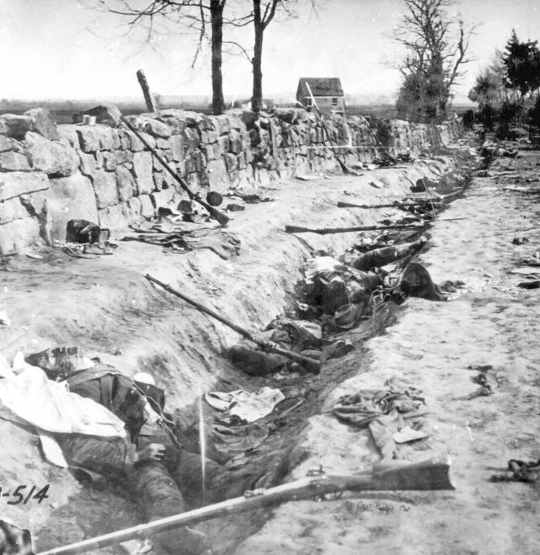
Reason 4: Photography. This is the biggest reason of all. Photography brought the war home to common people. Corpses and units were the most common object to be photographed. It is the first use of visual media in wartime.
All of a sudden, the thought of war is not so far away because you are able to see it on paper. No one, solider or civilian, can escape the "Horrors" of war. We see this practice all the way through Viet Nam, and soon after censorship is placed on media in wars.

Reason 1: The vast amount of people that fought in the war. There were 22 million people to use in fighting for the North, whereas the South only had 9 million people. Within that 9 million deep pool, 3.3 million were slaves. This allowed for Generals Grant and Lee to use each other's ecomonies and population as strategies. Grant would exhaust the South...physically and morally...because he had the greater amount of men to use. It would be like an never-ending wave after wave of men. Lee would use the North's industrious economy mindset to his advantage...wishing to exhaust all efforts to supply, feed, and finance the North army.
Reason 2: The Civil War was one of the first wars to of modern weapons. The Revolution, the War of 1812, the Mexican-American War, etc. used muskets. Stuff the bullet which was quite a large ball of metal, stuff it down with some powder and ignite so the bullet can fly. The musket was revolutionized during the Civil War Era by the concept of the rifle. The rifle allowed accuracy on moving targets. A ridge within the barrel helped the bullet maintain its path, so the shooter could hit a moving target better than a musket. Whereas with a musket you would shoot straight ahead and pray you hit something, the rifle was deadlier. Running soliders had more of a chance of being hit than ever before.

Reason 3: The Civil War was bloody on the field and in the operating room. Medical treatments resulted heavily on amputation. This is where we see amputation sky rocket as an effort to save soldiers's lives.
Reason 4: Photography. This is the biggest reason of all. Photography brought the war home to common people. Corpses and units were the most common object to be photographed. It is the first use of visual media in wartime.
All of a sudden, the thought of war is not so far away because you are able to see it on paper. No one, solider or civilian, can escape the "Horrors" of war. We see this practice all the way through Viet Nam, and soon after censorship is placed on media in wars.
Friday, January 1, 2010
Hindemith and Hitler
I think one of the lesser known history stories is that of Paul Hindemith and Hitler. Hindemith was a violinist turned violist, and composer. After the production of his opera Mathis del Maler =, which involved the background of the Peasant's Revolt of 1524-1525, he caught the eye of the one and only Adolph Hitler. Fearing the publics reaction to the idea of rebellion against a powerful institution, Hitler put Hindemith on the degenerate music list. Also for his loud opinions of keeping Jewish people in orchestras, Hindemith became a likely target for the Nazi leader and fled the country. He fled to Switzerland with his wife, who happened to be I believe half Jewish. There he wrote several pieces of music including the Sonata for Trumpet and Piano, which often is seen as a protest piece against the Nazi regime. The third movement includes a funeral theme, which can only be assumed to represent Hindemith's grief over losing the Germany he once loved and knew.


Subscribe to:
Comments (Atom)